Welcome to AI AWARE
The frontline AI detector for video, audio & text.
AI detection for brand reputation and security.
12million+ pieces of content tested
AI DetECTION PLATFORM
One platform. Four powerful AI detection capabilities.
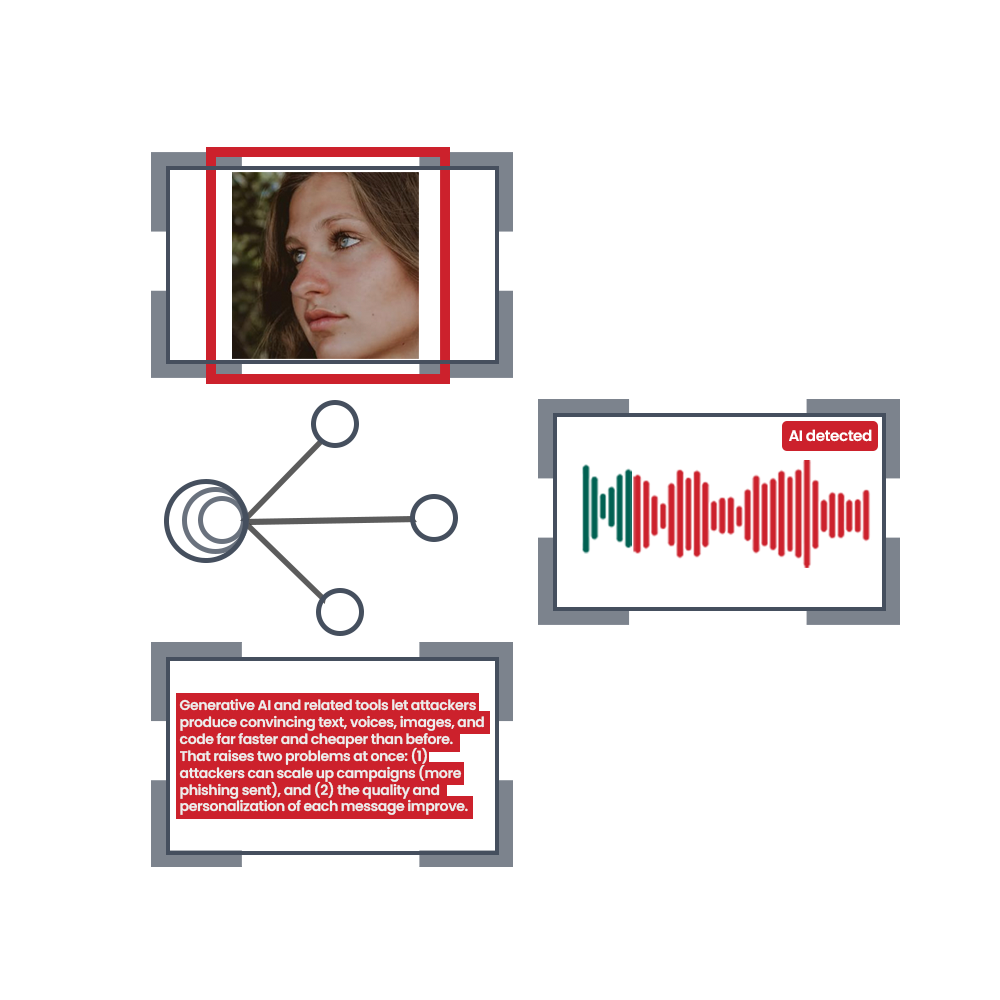
Our unified platform covers every major modality of AI-generated content.
AI Text Detection
Detect content written by large language models including ChatGPT, Claude, Gemini, Grok, and others. AI Aware analyses writing patterns, sentence structure, statistical fingerprints, and semantic signals that are characteristic of machine-generated prose whatever AI generator had been used. Our text detector provides a clear confidence score and explainable output, not just a binary verdict.
Common use cases: Students demonstrating that content is human, academic integrity checks, legal document reviews, editorial quality assurance, recruitment screening, content marketing audits.
Deepfake Video Detection
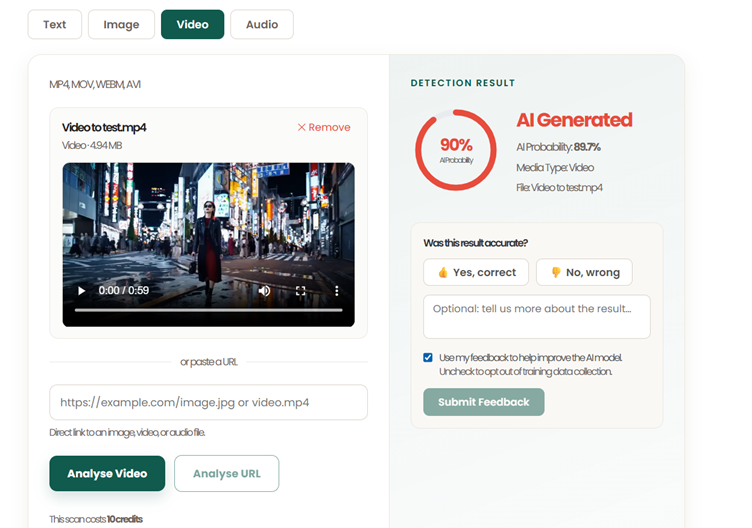
Deepfake video is one of the fastest-growing threats to personal safety, brand reputation, and public trust. AI Aware’s deepfake detector analyses facial inconsistencies, unnatural blinking patterns, lighting artefacts, and temporal anomalies across video frames to identify AI-manipulated or AI-generated footage.
Common use cases: Brand protection, corporate communications verification, fraud prevention, journalism fact-checking, social media moderation.
AI Image Detection
Generative image tools like Midjourney, DALL·E, Stable Diffusion, and Firefly can produce photorealistic images indistinguishable by people. AI Aware’s image detector examines pixel-level artefacts, unnatural texture repetition, and metadata inconsistencies to determine the likelihood that an image was AI-generated or AI-manipulated.
Common use cases: Insurance fraud detection, news and media verification, e-commerce product image auditing, legal evidence review, social media trust and safety.
AI Audio Detection & Voice Clone Detection
Voice cloning technology can now replicate a person’s voice from as little as three seconds of sample audio. AI Aware’s audio detector analyses speech patterns, prosody, background noise signatures, and spectral characteristics. AI Aware detects AI-generated speech or audio that has been synthesised or manipulated.
Common use cases: Fraud and financial crime prevention, call centre security, HR and interview integrity, political content verification, podcast and media authenticity.
Accuracy
AI Aware Accuracy Results
-
Video / Image
99.3% AUROC 0.999 · AP 0.999 -
Audio
97.4% AUROC 0.993 · AP 0.994 -
Text
98.2% AUROC 0.996 · AP 0.996
Check your content
See if your content is AI-generated. No obligation. No credit card required.
Why AI Detection Matters
AI-generated content is everywhere. More than 20% of content published online contains material that has been fully or partially produced by a generative AI model. From social media posts and news articles to legal briefs and job applications, the line between human and AI-generated content is becoming harder to identify.
The consequences of failing to detect AI-generated content are real and growing. Organisations face brand damage. Legal companies are losing cases due to AI-hallucinated citations. Fraud and identity theft driven by deepfake video, voice cloning, and synthetic identities are growing.
AI Aware exists to solve these problems. Our platform gives businesses, institutions, the public sector and individuals the confidence to know exactly what they are dealing with.

Our Company
Who we are
Our founders have a mix of commercial and technical expertise having built data companies worth over £20m. They have built a range of AI-based products.
AI detectors
What our AI detectors can do
01.
Detect AI-generated text
Reveal articles spreading misinformation, hallucinated case law in legal documents and academic essays written by products like chatGPT.
02.
Detect AI-generated images & videos
Increasingly used for scamming, and spreading fake news online via deepfakes it’s hard to know what is real anymore.
03.
Detect AI-generated audio
From video calls to voice cloning and deepfake audio, we can help you detect if the audio is generated by AI or if someone is reading from an AI script.
Use cases
Deepfakes & Cyber Attacks
Used to spread fake news and enables social engineering and phishing to be highly personalised attacks.
Document creation
Essays, articles, and social media posts can all be detected. As well as incorrect references in legal and scientific documents.
Job applications
CVs, cover letters, and written tasks can be scanned for AI to help you find the top candidates, and not the AI-generated ones.
Fraud
AI has enabled criminals to use synthetic identities, use AI for identity theft, and to generate fake contracts.
HOW OUR AI DETECTORS WORKS
The science behind AI Aware
AI Aware is an entrepreneurial and creative UK AI deep tech start-up that has been pioneering AI detection since 2023. The company, with support from Innovate UK, has developed an innovative approach to AI image, video, audio and text detection and manipulation. Many AI detectors rely on a single model trained on a fixed dataset. This is a problem as AI generators evolve constantly. AI Aware takes a fundamentally different approach.
Agentic AI detection architecture
Our platform uses a proprietary ensemble framework that combines multiple detection models, each with different strengths, training data, and analytical approaches. We use an agentic AI layer to update these models using AI and human data. By aggregating models and using agentic AI to update them, we achieve higher accuracy and greater robustness than any single-model approach.
Out-of-distribution resilience
One of the hardest problems in AI detection is identifying content from generators the detector has never encountered before. AI Aware’s architecture is specifically designed to handle these ‘out of distribution’ inputs such as hybrid content that simpler detection tools fail with.
Statistical fingerprinting
Every major AI generator leaves subtle statistical traces in its output: patterns in token probability distributions, characteristic phrase structures, and spectral signatures in audio and video. AI Aware incorporates statistical fingerprinting techniques that identify these traces even when content has been post-processed or paraphrased.
HOW OUR AI DETECTOR WORKS
Frequently Asked Questions
What makes AI Aware different from other AI detectors?
Most AI detectors do one thing: check text. AI Aware does four. We detect AI-generated and manipulated content across text, video, audio, and images all from a single platform. That breadth matters because AI threats rarely arrive in just one form. A fraudster might send a cloned voice note, a deepfake video, and an AI-written message as part of the same attack.
We are also one of the only detectors built on an ensemble framework. This is a combination of multiple detection models rather than a single algorithm. This makes us significantly more accurate on hybrid and manipulated content, which is exactly the content bad actors use to defeat simpler tools.
Can AI Aware detect content that has been edited or ‘humanised’ to avoid detection?
Yes. This is one of the areas where AI Aware outperforms single-model detectors. A growing industry of ‘AI humaniser’ tools exists specifically to defeat basic detectors. These tools rewrite or paraphrase AI content to raise its perplexity score, which is the main signal that simpler detectors use. AI Aware’s looks for deeper structural and linguistic patterns that humaniser tools do not fully erase. It has specifically tested and trained on hybrid content (AI content edited by humans) and manipulated content (human content altered by AI). These are the hardest cases – and the most common ones in real-world misuse.
How confident can I be in the results? What is the false positive rate of AI Aware?
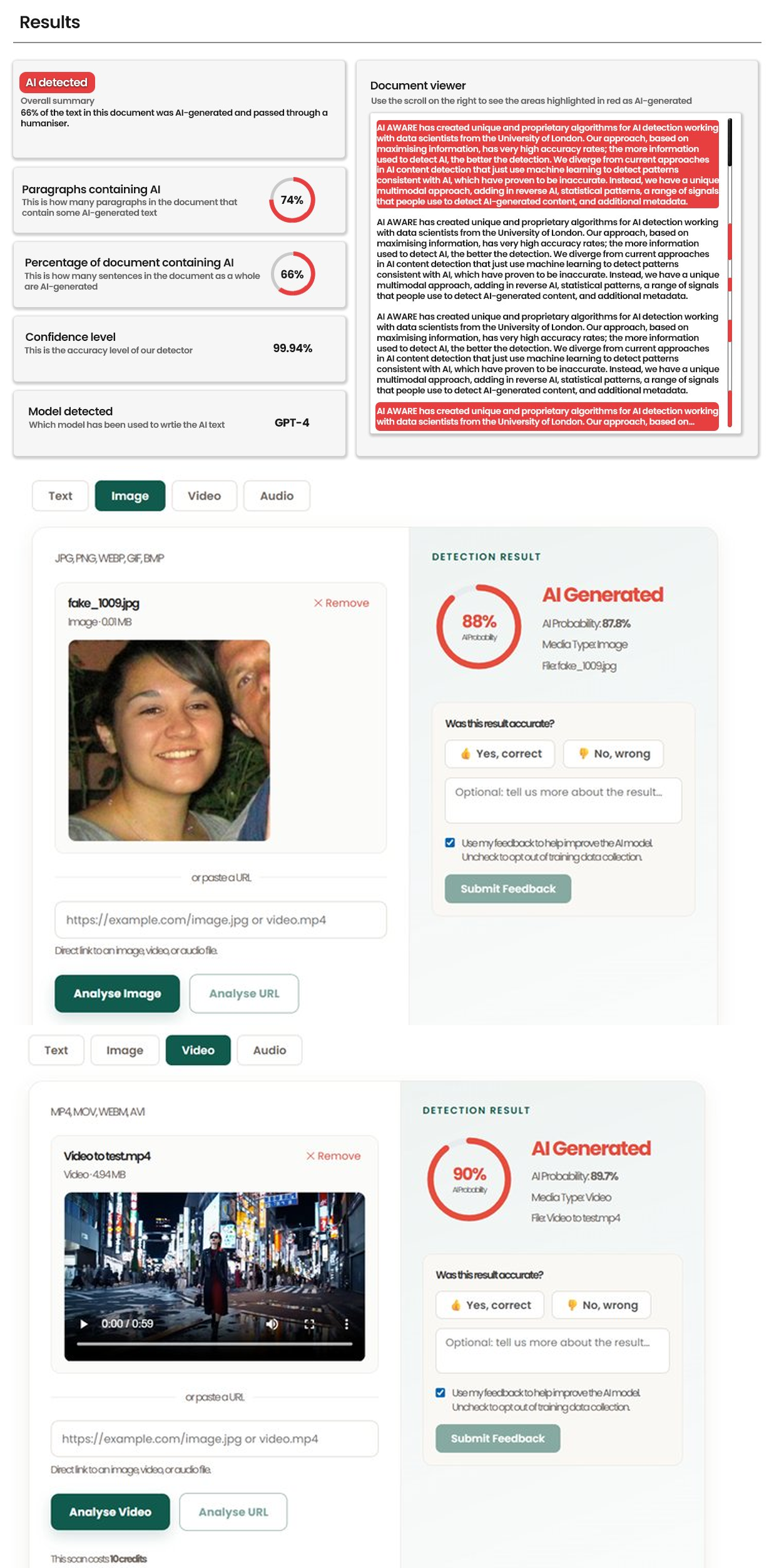
Confidence is everything in AI detection. This is the area where many tools let users down. A detector that wrongly declares human content as AI reduces credibility and can lead to false accusations. AI Aware provides calibrated confidence scores rather than binary verdicts. This means users see not just whether content is flagged, but how confident the system is. AI Aware’s false positive rate for text detection at the document level is less than 1 in 1,000. See benchmarking of AI Aware vs other AI text detection systems. The visualisation tool shows you where AI content appears in a document, so you can make an informed, contextual judgement, not just accept a percentage.
Which AI generators can AI Aware detect?
The AI Aware text detector identifies content from all major large language models, including ChatGPT (all versions), Claude, Gemini, Grok, and LLaMA. The deepfake and video detector is trained on output from leading AI video generators including Synthesia, Sora, Runway, HeyGen, and Seedance. Voice cloning tools including ElevenLabs and similar synthesis platforms are covered by the AI audio detector. As AI Aware’s methodology does not just rely on fingerprinting individual models, the platform detects AI generators not seen before, keeping pace with the threat landscape.
Which industries most need AI content detection?
AI content detection is needed by any organisation that needs to make confident decisions about the content it handles. This includes legal and professional services where AI detector users can authenticate documents, contracts, and submitted evidence. In education, students can prove that their work (or sections of it) are human. For academic institutions, they can detect AI-written essays and dissertations to protect academic integrity. In media and publishing AI content detector users can verify articles, images, and video clips before publication to protect reader trust. Workers in HR and recruitment can screen applications and video interviews for AI-generated content. For financial services and fraud teams, an AI detection platform assists with the detection of synthetic identities, AI-generated documents, and voice-cloned authorisation calls. With cybersecurity, an AI content detection system identifies AI-generated phishing content and deepfake social engineering attacks before they cause damage. The public sector can check fraudulent documents, misinformation and social engineering.
If your use case is not listed, get in touch. We work with partners to build tailored solutions.
How quickly does AI Aware return results?
Fast. Upload your content (whether it is a document, image, audio clip, or video file) and you will have your detection result in seconds. AI Aware is built for people who need to move at pace: journalists on deadline, fraud investigators reviewing a suspicious call, recruiters screening a high volume of applications. There is no lengthy processing queue.
What is a confidence score, and why does it matter?
Most AI detectors give you a single percentage or a traffic light. AI Aware gives you a confidence score alongside a breakdown of which parts of the content are driving the result. This matters because context is everything. A document that is 40% AI-generated might be a problem or it might not, depending on whether that 40% is concentrated in a key section or spread throughout. The AI Aware paragraph-level analysis and visualisation tool let you see exactly what is happening inside a piece of content, so you can make decisions based on evidence rather than a number.
Can I try AI Aware before committing?
Yes. Start with a free trial directly – no technical setup is required, no sales call needed. You can test the platform on your own content and see the results for yourself. For organisations needing high-volume detection, API access, or a tailored enterprise integration, contact our team to discuss what works for you.
- Accuracy: proportion of samples classified correctly (real as real, AI as AI), measured at the standard 0.5 threshold.
- AUROC (area under the ROC curve): Measures whether the detector ranks AI samples as AI above real ones. 1.0 is perfect, 0.5 is a coin flip.
- AP (average precision): Similar to AUROC focuses on the reliability of AI flagging across all thresholds. 1.0 is perfect.
Results are from validation sets of unseen samples from the same sources as the training data.
PARTNERSHIP
Get in touch to find out how we can work with you.
In PARTNERSHIP WITH