
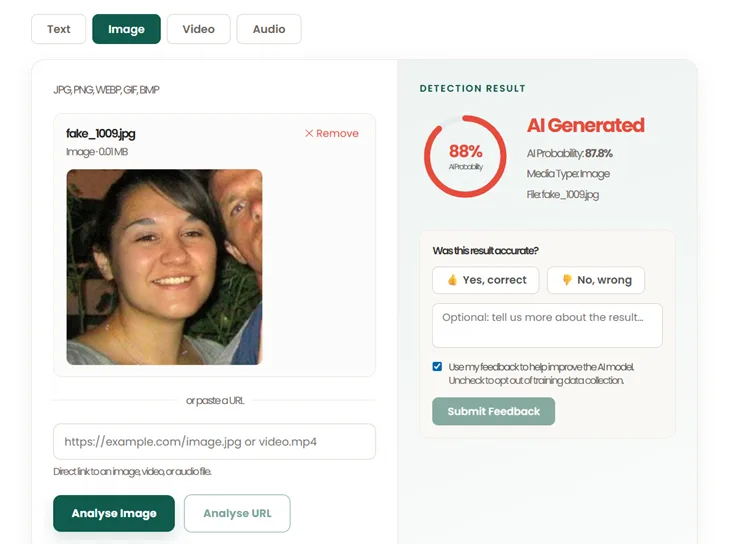
AI Image Detection
Why use an AI image and photo detector?
Detect whether an image has been generated by artificial intelligence or by a person
AI Image Detector
AI Aware’s detector identifies whether an image has been generated or manipulated by artificial intelligence
Our AI image detector does not rely on simple heuristics or surface-level visual checks. It is built on a multi-layer machine learning system trained on millions of real photographs and images produced by leading generators including Stable Diffusion, Midjourney, DALL-E, Adobe Firefly, and Getty’s Generative AI. This is combined with additional models and sophisticated techniques.
How AI image Detection works
Our system examines low-level pixel data such as noise distribution, texture regularity, and compression artefacts that differ systematically between camera-captured and AI-synthesised images. Generative models leave characteristic statistical signatures that are invisible to the human eye but detectable at scale.
We combine these statistical techniques with generative model fingerprinting as each major AI image generator produces subtle but consistent fingerprints in its output. AI Aware’s models are trained to recognise these generator-specific patterns, enabling identification of whether an image is AI-generated. In addition, we combine models to move beyond fully AI-generated images. Our AI Image detector identifies hybrid manipulation (cases where AI tools have been used to edit, inpaint, or extend an otherwise real photograph). This catches deepfake compositing, AI-retouched faces, and generative background replacement.
Confidence scoring & explainability
Every analysis returns a clear confidence score rather than a binary verdict, giving you a calibrated probability that the image is AI-generated. This nuanced output helps users make informed decisions rather than acting on a single yes/no answer that lacks context.
Which businesses should use an AI image detector?
News and media publishers can verify the authenticity of submitted images before publication. They can protect editorial credibility and avoid becoming a vector for AI-generated disinformation or synthetic propaganda.
Legal and compliance teams can authenticate images presented as evidence in litigation, claims, or regulatory submissions.
For online retail brands, AI image detection ensures product listings, supplier images, and user-generated reviews are authentic. It can also be used to identify use by competitors using AI-generated content to mislead buyers.
For insurance companies and other financial institutions, AI image detection identifies fraud and reduces other risks.
With stock photography platforms, AI image detection allows the screening of contributor submissions at scale to protect the integrity of libraries and maintain licensing compliance.
In education, the identification of AI-generated images submitted in academic portfolios, design coursework, or visual arts assessments is an important element in maintaining standards of authentic creative work.
With marketing and advertising agencies, detecting AI-images is important when working with brands where authenticity is key. There is brand risk form unwittingly incorporating AI-generated imagery into campaigns.
In the public sector it is important to validate benefit claims, identity documents, and public communication.
Another area for AI-generated image detection is recruitment where AI generated profile photographs used as part of fraudulent candidate identities are a growing issue, especially in remote hiring.
Frequently Asked Questions
The key commercial benefits are brand protection and reducing risks. Misinformation spreads at the speed of social media. Catching AI-generated images before publication or sharing prevents an organisation from amplifying synthetic content and the reputational damage that can follow. In financial services and areas such as recruitment, detecting AI images reduces fraud.
AI Aware combines machine learning with other statistical approaches. As it’s models are not just trained on signatures from particular AI generators but also wider patterns in images, it’s AI image detector works across all generators not just one.
Yes, the AI aware image detection system is API accessible, allowing teams to embed image authentication directly into content management systems, upload pipelines, or moderation dashboards.
AI Aware checks text, images, video and audio in a single platform. Unlike other tools that handle only one of AI-generated images, text or video, AI Aware covers all modalities (text, audio, video, and images) making it uniquely suited to organisations that manage diverse content types under one compliance framework.
Yes. The AI image detector can be used immediately without an account for individual image checks. For teams requiring higher volume, batch processing, API access, or integration into enterprise workflows, please contact us to discuss commercial plans.
Proven detection
AI Aware has built it’s AI media detection systems using large scale machine learning combined with sophisticated additional statistical techniques to identify the differences between AI-generated and human created images.
AI Aware’s other AI detection products
AI Aware was founded in 2023 with computer scientists at City St George’s, University of London, and its founders have over 20 years of AI experience. In our latest tests it was 99.4% accurate on images, and we publish results for generators such as Midjourney, DALL·E, Stable Diffusion and FLUX.