
On 25 May 2026, the Financial Times columnist Stephen Bush wrote about ‘The Serpent in the Grove’, the winning entry in a short story prize published by Granta. We ran the story through AI Aware’s text detector. It found compelling evidence that the story was generated by AI.
What the analysis shows
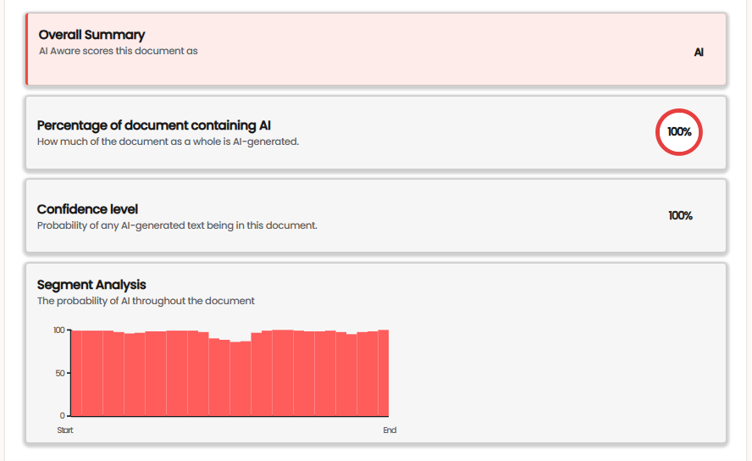
AI Aware doesn’t give a single yes or no. It analyses a document section by section and gives each section a calibrated probability that it was written by AI. Across ‘The Serpent in the Grove’, almost every section scored very highly for AI generation.
There are small dips in the AI level at a few points in the story. These most likely show minor human edits made to AI-generated text. This pattern fits with a writer generating a draft with an AI tool, then changing a few words or sentences or, alternatively, with submitting it and then an editorial team tweaking it before publication. Section-by-section analysis makes these edits visible, whereas a single overall score would hide them.
The consequences for publishing and literary prizes
Literary prizes reward original human writing. Judges, editors and readers trust that a winning story was written by the person who entered it. AI tools produce fluent, convincing polished fiction quickly, and many prizes and publishers have no reliable way to check submissions.
This raises questions for publishers and writing prize competitions:
- Should entries be checked for AI before judging?
- What counts as acceptable AI assistance, such as spelling and grammar tools, compared with AI-generated text?
- How should a prize respond if a winning entry shows significant signs of AI?
Clear rules, published in advance, and a consistent way to check entries protect both the prize and honest writers.
How publishers and prizes can check submissions
- Set a clear AI policy and include it in your entry rules.
- Check shortlisted entries with an AI text detector that analyses each section, not just the whole document.
- Look at where AI is flagged, not just the overall score. Small dips can show where a person has edited AI text.
- Give writers a chance to respond, for example by sharing drafts or notes. Drafts help show how a piece was written.
- Keep a record of the checks for each entry.
AI Aware can be used by publishers to check manuscripts, articles and submissions. See AI detection for publishing.
About AI Aware’s text detector
AI Aware’s detector has been developed over the past three years with computer scientists at City St George’s, University of London. It has been tested with over 15 million pieces of content and is 98.6% accurate on text, with the method published on our accuracy results page. It detects text from all major AI models, including ChatGPT, Claude, Gemini and Grok, and shows exactly which parts of a document were flagged.