
ContentChecker
Why use AI Aware’s Text Detector?
AI text detector checks whether text has been generated by artificial intelligence or by a person
AI text detection
Our AI text detector allows you to detect Artificial intelligence (AI) generated text and differentiate between AI generated text, human and hybrid (a mix of each). It can be used for all forms of text content such as academic work, legal documents, employment applications, or know your customer checks (KYC). The product identifies generated content from all AI models, including ChatGPT, Claude, Gemini and Grok. It uses a unique approach combining a range of techniques and can detect AI-generated text at the paragraph level giving calibrated probabilities.
Our approach is world leading and has very low error rates compared to other approaches. It also detects AI generated text that has been manipulated by people or with online tools. This text could have been plagiarised or adjusted. Our AI text checker works by looking at the relationship between words in a document as well as comparing human and AI-generated content to identify factors such as linguistic construction, creativity and logic.
Visualisation Tool
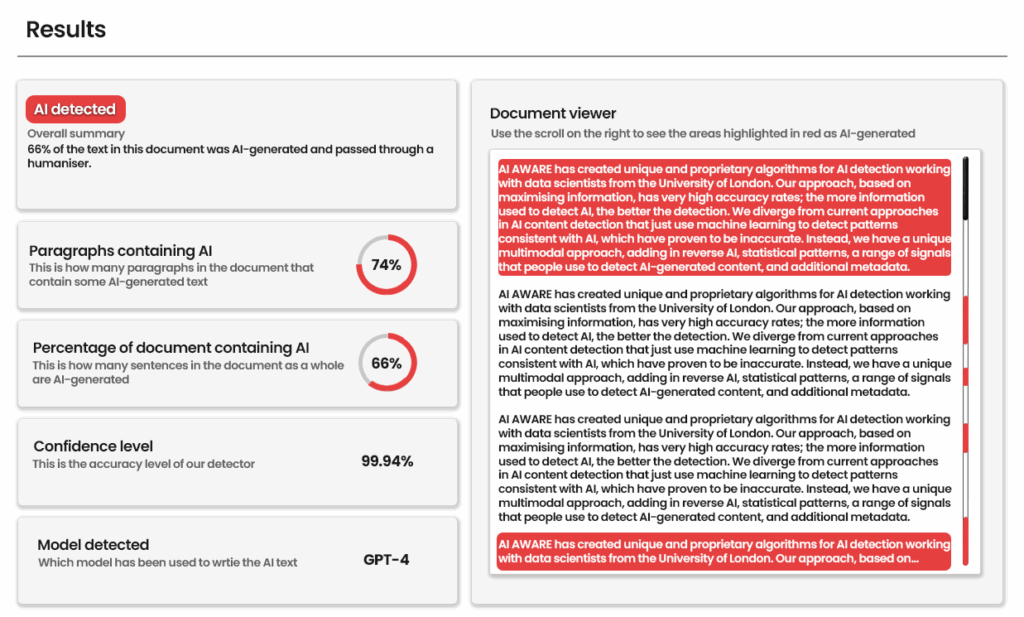
AI Aware’s visualisation tool shows the proportion of AI-generated content and whether it occurs in blocks or is dispersed. This allows you to contextualise the findings and understand the significance of AI-generated input.
Other systems give an overall percentage, which is difficult to understand. Our AI text detector goes beyond this and grades each section of text as AI or human generated content, showing its consistency with either. This means that users can get an overall view of a document and understand what is AI and what is human created.
The importance of calibrated probability scores
AI Aware outputs calibrated probability scores at the paragraph level so that each section of a document receives a score reflecting the confidence with which it is classified. Calibrated probabilities matter because they allow users to make proportionate decisions. A section scoring at 95% AI-generated warrants a very different response from one scoring at 55%. A percentage-across-the-whole-document metric obscures this nuance, potentially flagging a document as problematic when only one section raises a concern, or conversely, giving a clean result when a problematic section is buried within otherwise human-written text.
Benefits of AI text detection for companies
If you work for a company, you can ensure compliance across your organisation. AI-generated text can be factually inaccurate and, because of the content used in training, can perpetuate biases.
Our AI text detector can be used by legal companies. Legal writing is characterised by precise, formulaic language that can superficially be flagged as AI-generated text by less sophisticated detection systems. AI Aware has worked with legal firms and compliance teams to screen documents including contracts, witness statements, funding applications and regulatory submissions, where the origin of content may have material implications.
Another area where AI text detection matters is recruitment. The use of AI to generate or rewrite CVs, cover letters and application responses has become widespread. For recruitment teams and HR departments, AI Aware provides a means of screening applications to identify where candidates may have delegated their application to an AI tool. This can be ok, but sometimes it is a factor that is relevant (e.g. to assessments of communication skills, attention to detail or genuine suitability for a role such as writing marketing copy).
For publishers, content agencies and brands, AI text detection allows content managers to verify the origin of submitted work before it is published. This protects against inadvertently publishing factually unreliable content, maintaining editorial standards, and avoiding the SEO risks associated with low-quality AI-generated material.
Financial institutions and regulated businesses conducting KYC checks may encounter AI-generated written responses in customer declarations, explanations of source of funds, or supporting documentation. AI Aware can be used as a supplementary screening tool to flag submissions that may warrant additional human scrutiny.
Benefits of AI text detection for academic institutions
Academic writing represents the most sensitive context for AI detection. AI Aware has been tested extensively on formal academic output (undergraduate essays, postgraduate dissertations, coursework submissions) to ensure that the kinds of complex, structured arguments produced by capable human students are not wrongly flagged. The system is calibrated to reflect the full range of academic writing styles.
For academic institutions, our AI text detector allows you to identify AI-generated content in essays with a high degree of accuracy. We have tested on large quantities of varied academic output to ensure that our false positive rate is orders of magnitude lower than other products. This means that you can be confident of using our product and won’t be falsely accusing students of using AI.
For students our AI-text detection system can be used to demonstrate that your content is not AI-written. Alternatively, if you have used AI, and your education institution allows hybrid content, our text detector can be used to show which parts are AI and which parts of human (rather than simply being flagged as AI). You can find out more about using our certification of writing.
Frequently Asked Questions
What is an AI text detector and how does it work?
An AI text detector analyses the language patterns, logical structure, sentence construction and creative variation in a piece of writing to determine whether it was produced by a human or an AI model. Human writing exhibits a natural unpredictability (e.g. in rhythm, word choice, argument flow and even minor inconsistencies) that AI models struggle to fully replicate. AI Aware’s detector identifies these differences using a combination of techniques, including signals that go well beyond the basic statistical measures used by simpler tools. The result is a nuanced, paragraph-level picture of a document’s origin, not just a single number.
Can AI text detection actually be trusted?
Yes – when the underlying technology is built rigorously and tested honestly. AI Aware was developed by data scientists with over 20 years of AI research experience, co-founded by a researcher from City University, London. The system has been tested on over 5 million pieces of varied real-world content (including academic writing, legal documents, professional submissions) to validate its performance before deployment. Crucially, AI Aware publishes an honest account of what its detector can and cannot do. We offer a low false positive rate, calibrated probability scores, and paragraph-level transparency that allows users to make informed, proportionate decisions rather than acting on a single opaque percentage.
What makes AI Aware different from other AI text detectors?
Most AI detectors were built for a narrow use case (such as blog content or student essays, optimised for a single detection metric and over-fitted to their training data). AI Aware was designed from the outset to serve a much wider range of professional and institutional contexts: universities, legal firms, publishers, compliance teams, HR departments and enterprise organisations. That breadth shapes everything about the product, from the diversity of training data to the paragraph-level visualisation tool that shows not just whether AI content is present, but where it appears and how it is distributed throughout a document. AI Aware also uniquely combines non-machine-learning approaches with large-scale ML, making it more robust and harder to fool than systems that rely on a single methodology.
Which AI models can AI Aware detect?
AI Aware detects content generated by all major AI language models, including ChatGPT (all versions), Claude, Gemini and Grok, as well as the full range of other large language models in active use. Because AI Aware’s detection approach targets the underlying characteristics of AI-generated language rather than the fingerprints of specific models, it remains effective as new models are released, without needing to be retrained from scratch every time an AI company pushed out an update.
How accurate is the AI text detector, and what is a false positive rate?
Accuracy in AI detection has two sides. The first is how reliably the tool catches AI-generated content. The second, and arguably more important in high-stakes settings, is how rarely it wrongly accuses a human writer. This second measure is called the false positive rate. AI Aware has achieved a very low false positive rate, meaning human-written content is correctly identified as human the overwhelming majority of the time, whilst maintaining a very high detection rate. This matters enormously in academic assessment, legal review and HR screening, where a wrong result can have serious real-world consequences. AI Aware’s low false positive rate is not a coincidence. It is the result of deliberate design choices and rigorous testing on diverse, real-world writing samples.
What does paragraph-level analysis mean, and why does it matter?
Rather than assigning a single overall score to an entire document, AI Aware grades each paragraph individually and assigns calibrated probability scores throughout. This means users can see precisely where AI-generated content appears — whether it is concentrated in the introduction, the conclusion, a specific section of argument, or dispersed across the whole document. This level of granularity transforms detection from a blunt instrument into a genuinely useful investigative tool. A document that scores 40% AI overall might mean something very different if that AI content is all in one block versus spread evenly. The AI Aware visualisation tool makes that distinction clear immediately.
Can AI Aware detect text that has been “humanised” or rewritten to evade detection?
Yes. A growing number of tools exist specifically to disguise AI-generated text by paraphrasing it, restructuring sentences or varying vocabulary to make it look more human. Simple word-swapping tools are relatively easy for AI text detectors to catch, because they change the surface of the text while leaving the underlying logical and structural patterns intact. More sophisticated humanising tools are harder to catch but AI Aware’s multi-signal approach, which analyses logic, linguistic construction and creative expression rather than surface statistics alone, is specifically designed to remain effective against manipulated content. For organisations where deliberate evasion is a real concern, this resilience is a key advantage of AI Aware’s methodology.
Is AI text detection reliable enough to act on?
AI Aware’s results are reliable enough to be used as meaningful evidence. The context of results is important. If a document is flagged as having AI throughout the reliablity of that result is, statistially, much higher than if AI is flagged only in one section. In academic settings, detection results should inform a conversation and guide further investigation. In business contexts such as content quality review, compliance screening, CV assessment — results can be acted on more directly, since the stakes of a false positive are lower and the volume of content being reviewed is typically higher. AI Aware is built for both contexts, and the calibrated probability scores it provides are designed to help users make proportionate, well-informed decisions rather than binary ones. For high stakes cases our data scientists can provide an additional written report that explains the statistical reliability of any finding. Please contact us to discuss this.
What types of documents can AI Aware analyse?
AI Aware is designed to work across all forms of written content including academic essays, dissertations, legal documents, compliance submissions, employment applications, CVs, published articles, marketing copy and KYC documentation. This breadth of supported document types reflects the platform’s origins in serious institutional and enterprise use. If your organisation has a specific document type or workflow in mind, the AI Aware team can advise on the best approach.
Does AI Aware work on content from newer AI models as they are released?
Yes. Because AI Aware’s AI text detection is built around the characteristics of AI-generated language in general (not the specific outputs of individual models) it maintains effectiveness as new models emerge. In addition, our data scientists actively monitor developments in AI generation and update the detection approach accordingly, ensuring that the product remains reliable even as the AI technology evolves.
How do I get started with AI Aware?
You can start immediately with a free trial (no credit card required). Register on the AI Aware platform, submit your first document and receive a full paragraph-level analysis within seconds. Credits are available to purchase if you need to analyse larger volumes of content, and enterprise arrangements are available for institutions requiring bulk access, API integration or bespoke reporting.
Market leading AI-generated text detection
AI Aware has built it’s AI text detector combining unique non-machine learning approaches with large scale machine learning to identify the differences between AI-generated and human created text.
We use various signals from human and AI content such as logic, linguistic structure and creativity to differentiate between the two.