
How the test worked
To understand how well a detector of AI-generated text works, we need to measure its accuracy on data where we know the original source, whether it is human or AI. At AI Aware, we have curated a large dataset and we use a sample of it for benchmarking AI detectors, to make sure we understand our performance and how it compares with other competitors.
Our dataset is based on the well-known M4 dataset (https://github.com/mbzuai-nlp/M4) but extended. We include more AI models, including the recent GPT-4o (and its mini variant), Google’s Gemini, Anthropic’s Claude, Grok and Llama. We also added more text genres, including fiction and non-fiction books, medical, poetry, and even recipes and have approximately 50% human and 50% AI text in all genres.
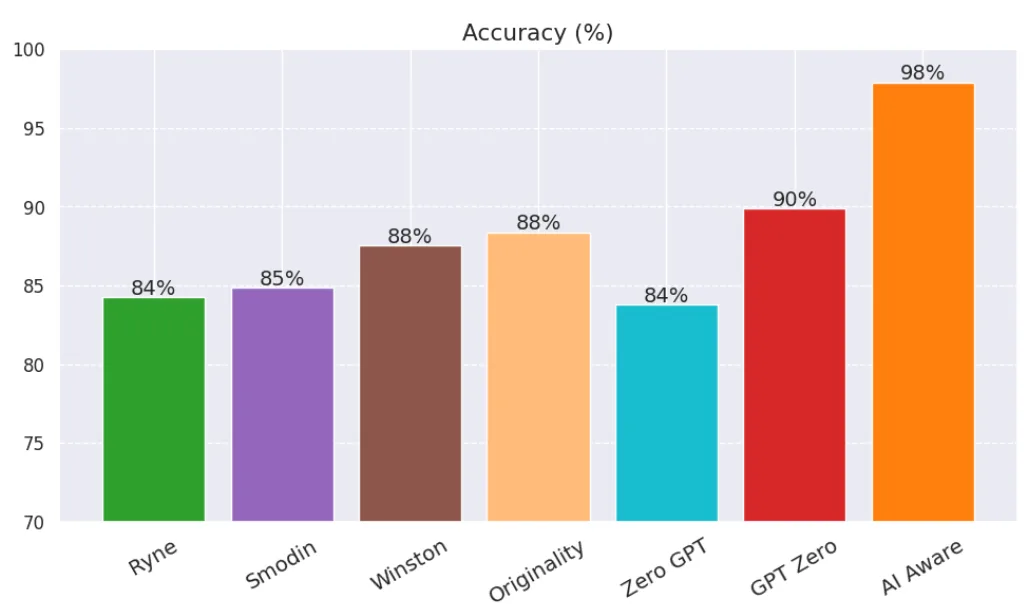
We put this text through the AI Aware detector and several competitors, including Originality.ai, goWinston.ai, GPT Zero, Zero GPT, Ryne.ai and Smodin.io. The metric for AI detection is the accuracy, i.e. the share of all text where the system gives a correct answer, and we found that AI Aware is correct 98% of the time, which is the best result on our dataset.
The other important metric is the precision, i.e. how many of the items detected as AI are actually AI. We have tuned our model to minimise the number of misdetections (false alarms) and come out with over 99%. This indicates that less than 1% of all texts shown as AI are actually human-written. While the precision of other detectors is not very much lower, the difference between 99% and 98% means a doubling of false alarms.
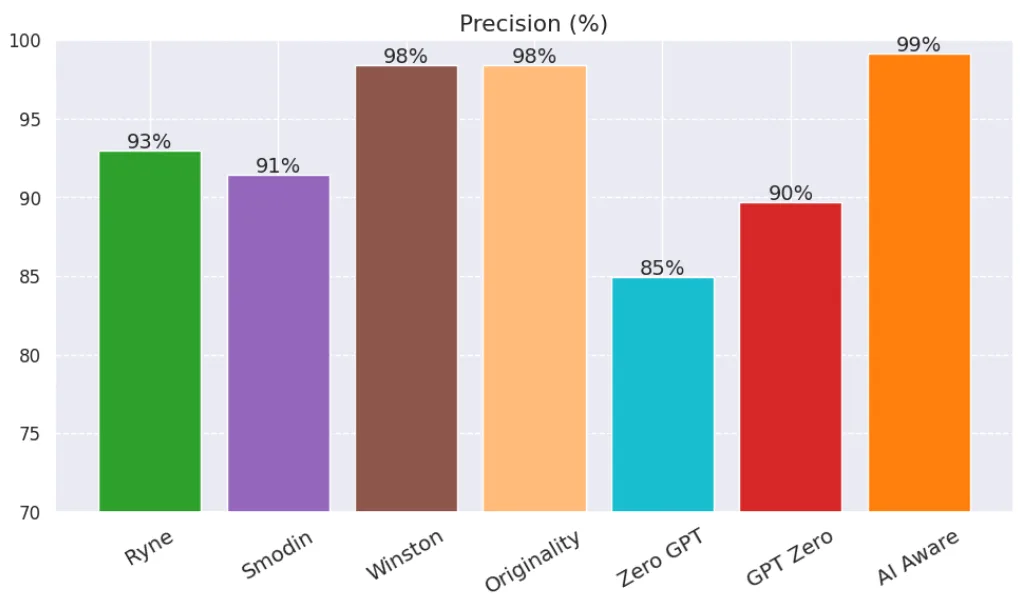
The other detectors that are similarly precise have overall lower accuracy, because they miss more of AI-generated text. We can see this when looking at the recall (how many of the actually AI-generated items are detected), where the other models with high precision fall behind.
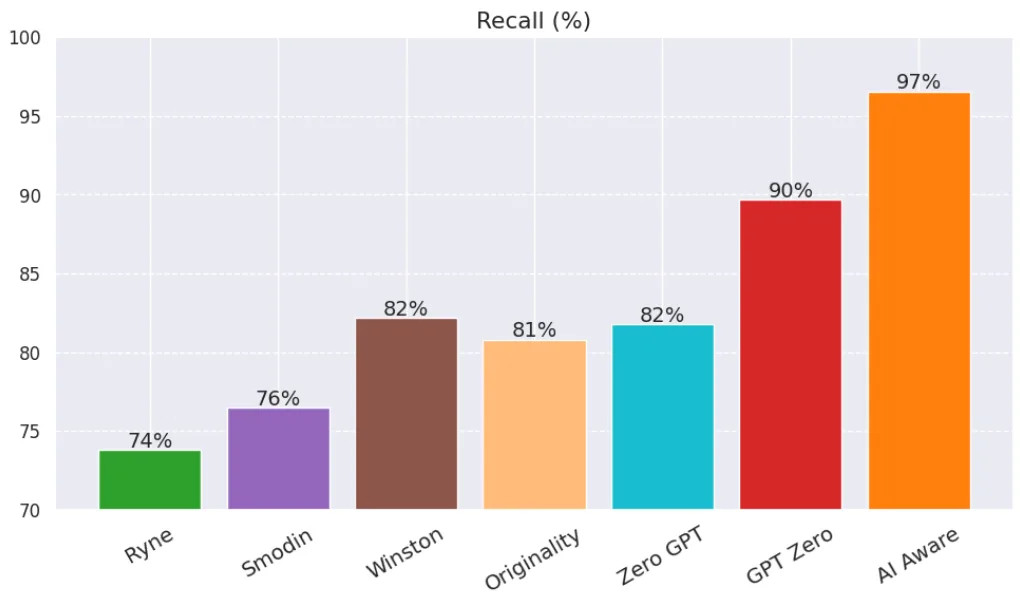
How the detectors compared
| Detector | Accuracy | Precision | Recall |
|---|---|---|---|
| AI Aware | 98% | 99% | 97% |
| GPT Zero | 90% | 90% | 90% |
| Winston | 88% | 98% | 82% |
| Originality | 88% | 98% | 81% |
| Smodin | 85% | 91% | 76% |
| Ryne | 84% | 93% | 74% |
| Zero GPT | 84% | 85% | 82% |
While results may vary on different types of data, AI Aware shows leading performance in terms of precision and recall, making it a reliable system for applications in diverse domains out of the box and with the option to fine-tune for different specialities.
The comparison above is from our August 2025 study. Our latest results for each detector are below.
Our accuracy results
Latest text results by type
Share of texts classified correctly, by type of writing, from a test of 10,334 texts the detector never trained on.
| Type of writing | Classified correctly |
|---|---|
| Academic | 99.2% |
| Encyclopedic | 98.5% |
| Fiction | 99.4% |
| Instructional | 99.0% |
| Legal | 97.5% |
| Listings and digests | 99.7% |
| News | 99.5% |
| Reddit posts | 98.8% |
| Reviews | 99.3% |
| Social media | 98.5% |
| WikiHow | 99.9% |
| Wikipedia | 99.4% |
Full breakdown by length and AI model: technical results.
How we measure accuracy
We test every detector on samples kept out of its training, then publish the results using the same measures.
Accuracy: the share of samples classified correctly.
AUROC: how well the detector ranks AI content above real content. 1.0 is perfect and 0.5 is a coin flip.
What we tested: we’ve run more than 15 million detection tests across text, images and audio, re-testing as our models are updated. Results are the best result from each detector between 14 August and 7 November 2026, using samples kept out of training and drawn from the same sources as our training data. For testing, video is broken into frames and each frame is tested as an image, so video and image share one figure. The audio figure uses a decision threshold calibrated on the same validation set. Results can be lower on new or unusual content.
Related article
AI Aware detects DeepSeek at first sight
Try the detector yourself
See the results for yourself with our AI text detector.
You can also check images, voice recordings and videos.